Saturday, May 2, 2009

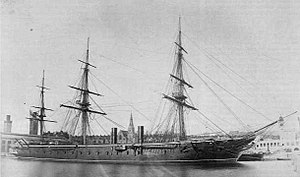
Ironclad gunboat Galena


This is my attempt to make the ironclad gunboat Galena drawing look like a photograph.

Saturday, April 18, 2009

Ranges

Old Brassey's have tables of ship data that include the range at 10 knots with a full coal bunker. I was amazed to see that the old broadside British ironclads from the 1860's had short ranges. The Warrior had a nominal range of just 1210 nautical miles. Clearly, the ships must have had a way to extend their range to cross the Atlantic. The either sailed in company with colliers and were able to transfer coal at sea or else would overload the ships with coal. The turret ship Neptune, purchased in 1878, only had a range 0f 1480 nautical miles. The ship had been built for Brazil, so that would account for the lack of range, but it made for a ship that had limited uses for the Royal Navy.

Saturday, April 4, 2009

The steam frigate Minnesota


The steam frigate USS Minnesota (1855) was a 4,833 ton unarmoured cruiser. Since large cruisers were called frigates at the time of her construction and early service, she was dubbed a steam frigate. Sailing frigates might be called that or just frigates. The steam powered ships had the "steam" prefix before their type name. The Minnesota was a 9-1/4 knot ship, although one source rates her at 12 knots. Her armament was 2-10in MLSB, 28-9in MLSB, and 14-8in MLSB. She served in the American Civil War and was present during the combat in 1862 with the Confederate ram CSS Virginia (formerly, the USS Merrimack, another steam frigate).

Saturday, March 21, 2009

Brassey's drawings

I first saw the old Brassey's (The Naval Annual) back in the mid-1960's. I had already seen the older Jane's, and I was amazed at the variation in quality of the ship drawings. They range from having been drawn from original plans, and showing accurate bulkheads and machinery positions to crude diagrammatic representations that are not to any scale. In the 1894 Brassey's, the ships named there as "Catherine II", "Tchesma", and "Sinope" have an accurate inboard profile and plan view. Just before, there is a crude diagram for the ship called there "Admiral Nachimoff" (drawings 63 and 64).

Monday, February 23, 2009

The paddle frigate Mississippi


The American paddle frigate Mississippi was a historic ship that came to a bad end in 1863. The Mississippi had been Matthew Perry's flagship when he forced the Japanese to open their country to the west. He had personally supervised her completion and fitting out and used his as his flagship. The Mississippi had played a role in the war with Mexico and then had gone to the Far East. She was laid up when the Civil War started. She was obsolescent in 1861, but was used in the capture of New Orleans in 1862, where she disabled the Confederate ram Manassas. Because of her low speed and paddle wheels, she was relegated to the Mississippi river. She was scuttled in 1863 during the attempt to push past Port Hudson. The Mississippi had run aground, under heavy fire, and couldn't be freed. She was burnt after her guns were spiked to keep her from being captured. An interesting note is that George Dewey, the victor of Manilla Bay in 1898, was her executive officer at the time of her loss. This is my enhancement of the photograph from 1863, when she was painted wartime gray.

Sunday, February 15, 2009

The Chinese belted cruiser Lai Yuan


The Lai Yuan was sunk at Wei-Hai-Wei on 5 February 1895 after being torpedoed by a Japanese torpedo boat Kotaka. The Lai Yuan was a steel cruiser with compound armour. The Lai Yuan was nominally 2,850 tons with dimensions of 270ft x 40ft x 16ft-6in. The compound belt was 9.5in thick with a 3in deck. The armament consisted of 2-8.2in 10 ton BLR, 2-6in 4 ton BLR, and 7 MG.

Sunday, February 1, 2009

The CSS Sumter


The Confederate raider Sumter had a short but successful career as a cruiser. The Sumter was purchased in New Orleans in April 1861 and was modified to carry an armament. She was originally armed with 1-8in shell gun and 4-32pdr MLSB guns. She had been built in 1869 in Philidelphia as the Havana. She was capable of between 9 and 10 knots. She was sold in 1862 after being chased by the USS Iroquois into Spanish waters.